Current location:
High-Performance Dies for Steel Wire Production: An Expert Guide
2026-07-31Steel wire drawing punishes dies in ways that copper and aluminum never come close to. The combination of extreme hardness, high drawing forces, abrasive oxide scale, and the cyclic thermal stress of continuous production means that a die supplier who knows copper well may know almost nothing about what it takes to survive in a steel wire mill. Getting high performance dies for steel wire production right means understanding wear mechanisms, selecting carbide grades built for abuse, and designing geometry that keeps drawing force manageable across the aggressive reductions that steel wire schedules demand. This guide is written for steel wire producers who are tired of dies failing faster than the specifications promised and want to understand what actually drives performance in their environment.
Understanding How Steel Wire Destroys Dies
The first step toward specifying high performance dies for steel wire production is understanding exactly what steel does to the die bore during drawing. Steel is abrasive. The oxide scale that forms on hot-rolled rod—even after descaling—leaves hard particles that grind microscopically into the die surface with every pass. This abrasive wear is the dominant failure mechanism for most steel wire dies, and any die specification that does not account for it is fundamentally inadequate.
Beyond abrasive wear, steel drawing generates extreme contact pressures at the die interface. High-carbon steel drawing at 20 percent reduction per pass can generate bearing pressures exceeding 1500 megapascals. At these pressures, the die bore material experiences sustained stress that accelerates all wear mechanisms simultaneously. A die that performs acceptably at 1000 megapascals may fail rapidly at 1500.
Thermal cycling compounds these problems. As the die draws wire continuously, the bore heats up; when the production run ends, it cools. Each thermal cycle creates microscopic expansion and contraction that, over hundreds of cycles, produces microcracking in the die surface. This thermal fatigue eventually creates a network of cracks that spalls off, leaving the bore surface ruined. Steel wire dies that work well for the first shift and fail by the third are often suffering from thermal fatigue, not abrasive wear.
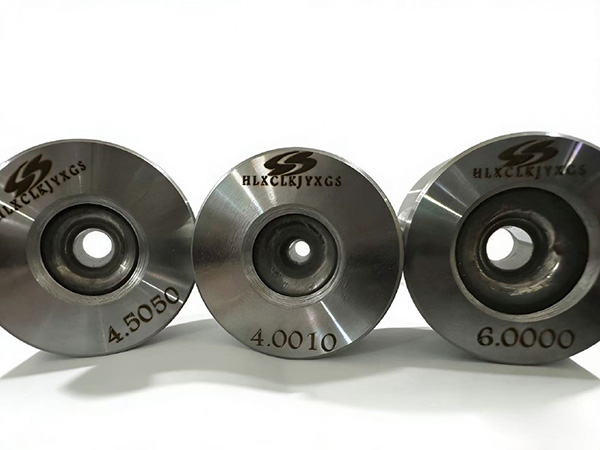
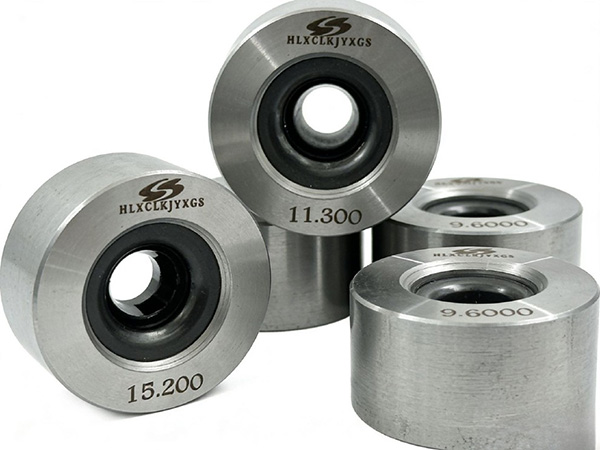
Carbide Grade Selection: Matching Hardness to Steel Hardness
For steel wire drawing dies, carbide grade selection is the most consequential decision after geometry. The grade determines how well the die resists the specific combination of abrasive wear, mechanical stress, and thermal cycling that steel drawing imposes.
Submicron carbides—grades with tungsten carbide grain sizes between 0.2 and 0.8 micrometers and cobalt content of 4 to 8 percent—deliver maximum hardness and wear resistance. These grades resist abrasive wear from oxide scale better than coarser grades. However, their lower cobalt content means lower fracture toughness, making them more susceptible to cracking under the shock loads that occur during threading and when wire breaks inside the die.
Medium-grain carbides (1.0 to 2.0 micrometer grain size, 8 to 12 percent cobalt) provide a practical balance for most high performance steel wire dies. They sacrifice some wear resistance compared to submicron grades but gain the fracture toughness needed to survive the mechanical shocks that steel drawing delivers regularly. A mill drawing high-carbon spring wire at aggressive reductions needs medium-grain carbide, not submicron.
For the most demanding applications—very high drawing speeds, highly abrasive stainless steel wire, or applications with frequent thermal cycling—a few specialized manufacturers offer gradient carbides with cobalt-enriched surface zones. These grades have maximum hardness at the bore surface where wear is concentrated while maintaining tougher cores that resist cracking. Gradient carbides represent the current frontier in steel wire die material technology, though they carry a significant cost premium.
Coatings That Actually Help Steel Wire Dies Survive
Surface coatings on steel wire dies face a harsher environment than coatings for copper or aluminum drawing. The high temperatures, abrasive particles, and chemical activity at the steel-die interface can destroy coatings that would perform well in softer applications. Choosing the right coating for high performance steel wire dies requires understanding what each coating actually does under steel-drawing conditions.
TiAlN coatings (titanium aluminum nitride) have become the standard for steel wire at the higher end of the speed range. The aluminum in the coating forms a stable aluminum oxide layer at elevated temperatures, protecting the underlying coating from oxidation degradation. TiAlN-coated dies in high-carbon spring steel drawing typically show 30 to 50 percent longer service life compared to uncoated carbide under equivalent conditions. The cost premium of 20 to 30 percent is usually justified within the first production run.
Chromium nitride coatings offer good abrasive wear resistance and perform well in stainless steel wire applications where chromium oxide particles from the wire surface attack the die bore. CrN coatings are less resistant to high-temperature oxidation than TiAlN but provide excellent performance at moderate temperatures where their superior abrasion resistance matters most.
Multilayer coatings—alternating thin layers of different coating materials—combine the benefits of multiple coating types. A TiAlN/CrN multilayer provides both high-temperature oxidation resistance and abrasion resistance in a single coating system. A few specialized die manufacturers have developed proprietary multilayer coatings specifically for steel wire applications.
Die Geometry for Steel: Designing Around Drawing Force
The geometry of high performance steel wire dies must be designed with drawing force as a primary constraint. Unlike aluminum, where the goal is minimizing surface defects, steel die geometry must manage the enormous forces that the material generates while keeping those forces within what the die and the drawing equipment can tolerate.
The approach angle controls how quickly the steel deforms as it enters the bore. Steeper angles concentrate deformation into a smaller zone, which increases local stress and drawing force but reduces total die contact length. Shallower angles spread the deformation over a longer distance, which reduces drawing force but extends the wear zone. For most steel wire applications, the optimal approach angle falls between 16 and 24 degrees included angle, with higher-carbon steels requiring steeper angles to manage their greater strength.
Bearing length for steel wire dies should be proportionally longer than for copper or aluminum. Steel's higher friction coefficient means that a longer bearing is needed to properly size the wire without excessive pressure. Bearing lengths of 40 to 60 percent of wire diameter are standard for steel, versus the 25 to 40 percent used for aluminum. Too short a bearing in steel drawing causes pressure concentrations that accelerate wear and generate heat.
Reducing Die Wear Through Process Optimization
Even the best high performance dies for steel wire production will fail prematurely without attention to the process conditions that accelerate wear. Several operational factors dramatically affect how long a die lasts in steel wire drawing, and mills that ignore them pay for it in shortened die life.
Descaling quality before drawing is the most impactful process variable. Any oxide scale that remains on the rod surface acts as an abrasive that grinds into the die bore. Mechanical descaling (shot blasting or brushing) followed by chemical pickling removes scale more completely than either method alone. Mills that invest in descaling quality consistently report longer die life and better wire surface quality.
Reduction schedule design matters enormously. Passes that apply more than 35 to 40 percent reduction in a single die generate excessive drawing force and bore pressure that accelerates all wear mechanisms. Keeping individual pass reductions below 30 percent typically doubles or triples die service life compared to aggressive schedules, even though more dies are required in the sequence.
Lubricant coverage and quality affect steel wire die life significantly. For dry soap drawing, the soap carrier (borax or phosphate coating) must be uniformly applied with adequate thickness. For wet drawing, emulsion concentration and cleanliness must be maintained within tight ranges. Lubricant system maintenance is not optional—it is a direct determinant of die life.
Common Steel Wire Die Failure Patterns and What They Mean
Experienced die managers at steel wire mills can often identify the cause of die failure from the wear pattern on the die bore. Learning to read these patterns saves significant troubleshooting time.
Uniform bore enlargement with smooth walls indicates normal abrasive wear from oxide scale. The die is functioning correctly; it has simply reached the end of its service life.
One-sided wear, with the bore worn larger on one side only, points to die misalignment in the holder. The die is not centered properly, causing all the force to be applied to one side of the bore. Correct the holder alignment and the wear pattern should normalize.
Cracking in the approach zone, particularly radial cracks radiating from the bore, indicates thermal fatigue. The die is being cycled thermally too aggressively—either from excessively long continuous runs or from inadequate cooling between runs. Shorter run cycles and improved cooling extend thermal fatigue life.
Frequently Asked Questions
Q1: What carbide grade should I use for high-carbon spring steel wire?
Medium-grain carbide with 8 to 12 percent cobalt content is the standard recommendation for high-carbon spring steel drawing. The higher cobalt provides the fracture toughness needed to handle the high bearing pressures and threading shocks that spring steel generates. Submicron grades are too brittle for the aggressive reductions spring steel requires.
Q2: How much longer do TiAlN-coated steel wire dies last compared to uncoated dies?
Under typical high-carbon steel wire drawing conditions, TiAlN-coated dies show 30 to 50 percent longer service life compared to uncoated carbide equivalents. The improvement is most pronounced at higher drawing speeds where die temperatures are elevated. At moderate speeds below 400 meters per minute, the improvement may be closer to 20 to 30 percent.
Q3: Can I run stainless steel wire through the same dies I use for carbon steel?
No. Stainless steel's different oxide structure and higher hardness cause different wear patterns that contaminate the die for carbon steel use. Additionally, cross-contamination between steel grades in the die bore can cause surface defects on both materials. Dedicate dies to specific steel grades.
Q4: How do I know when a steel wire die should be replaced versus reconditioned?
Replace when bore diameter has exceeded the upper specification limit for your finest wire size, when surface cracking (thermal fatigue) is visible in the approach zone, or when the die has been reconditioned four or more times and is approaching minimum wall thickness. Recondition when surface polish has degraded but geometry is still within tolerance.
Q5: What is the most important factor in extending steel wire die life?
Descaling quality before drawing is the single most impactful factor. Complete removal of oxide scale eliminates the primary abrasive that grinds into the die bore. Mills that invest in optimal descaling typically see 40 to 60 percent longer die life compared to mills using marginal descaling, regardless of what other process improvements they implement.
Conclusion
Specifying high performance dies for steel wire production requires matching carbide grade, coating, and geometry to the specific demands of the steel being drawn and the production conditions in the mill. Medium-grain carbide handles the mechanical stress of high-carbon spring steel; TiAlN or CrN coatings extend wear life in high-speed applications; geometry must manage drawing force rather than simply replicate generic designs. Descaling quality and reduction schedule design determine whether even the best die performs well or fails prematurely. Work with a die supplier who understands steel wire specifically—not just wire drawing in general. The right tooling partner brings application engineering expertise that translates directly into longer die life, better wire quality, and lower total tooling cost per ton of production.
References
Martinez, C., & Chen, Y. (2023). Wear Mechanisms in High-Performance Carbide Dies for Steel Wire Drawing. Wear, 520-521, 204736.
Thompson, R., & Liu, J. (2022). TiAlN Coating Performance in High-Carbon Spring Steel Wire Drawing Dies. Surface and Coatings Technology, 441, 128541.
Park, S., & Williams, D. (2023). Reduction Schedule Optimization for Extended Die Life in Steel Wire Manufacturing. Journal of Manufacturing Science and Engineering, 145(7), 071004.
ASTM International. (2023). Standard Specification for Tungsten Carbide Dies for Wire Drawing (ASTM B702-23). West Conshohocken, PA.
Wire Association International. (2023). Steel Wire Drawing: Process Optimization and Tooling Best Practices. Guilford, CT: WAI Technical Publications.