Current location:
Aerospace Wire Dies: Drawing Die Technology for Aerospace Manufacturing
2026-08-18The aerospace industry does not have quality problems. It has aircraft that crashed. That framing, familiar to anyone who has worked in aerospace manufacturing, captures the stakes that drive the sector's approach to supply chain management. When aerospace wire dies produce a batch of wire with defects, those defects might be part of a sensor loop in an altitude hold system, a conductor in a fire detection circuit, or a structural cable in a landing gear assembly. The defect must not cause the system to fail. This logic shapes everything about how aerospace wire manufacturers specify and procure their drawing dies, and it is a logic that any die supplier attempting to enter the aerospace market must internalize completely.
Aerospace Wire Applications and Their Drawing Die Requirements
Aerospace wire is not a single product category. The industry uses distinct wire types for different systems, and each type has its own drawing die requirements that a die manufacturer must understand to serve the market properly.
Aircraft primary wiring—the conductors in the airframe wire harness—represents the highest volume aerospace wire application. These are typically aluminum or copper conductors, insulated with specialized aerospace-grade polymers that resist flame, smoke, and toxicity in the event of a fire. Drawing tolerances for primary wiring are tighter than standard industrial wire but not at the extreme end of what precision dies can achieve. The primary quality concern is consistency across production runs, not the ultimate precision that medical or aerospace sensor applications demand.
Aerospace sensor wire and thermocouple lead wire represent a more demanding segment. Temperature sensors, pressure transducers, and position sensors throughout the aircraft depend on consistent electrical properties, which in turn depend on consistent wire geometry and surface condition. Any variation in diameter creates variation in resistance that affects sensor calibration. Any surface irregularity can compromise the integrity of the sensor junction. Aerospace wire dies for sensor applications must deliver tighter tolerances and better surface finishes than standard primary wiring.
Aerospace structural cable—cable used in flight control systems, cargo handling, and other mechanical applications—falls somewhere between electrical and mechanical applications. These cables must have precise mechanical properties set by the drawing process, with consistent tensile strength and surface condition. Die geometry directly affects the work hardening and surface characteristics that determine cable performance, making the die manufacturer an active participant in the mechanical design process.
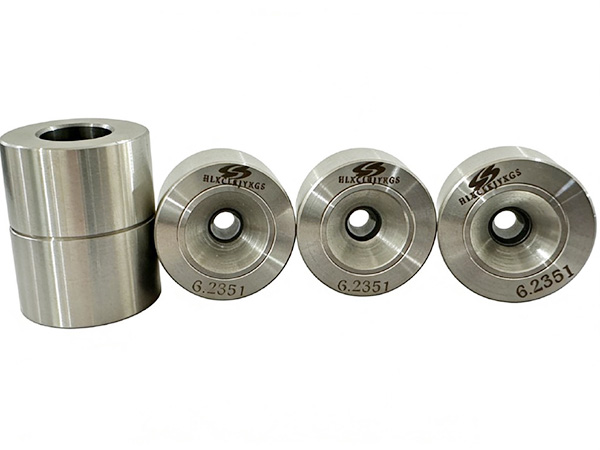
The Aerospace Supply Chain Qualification Framework
Entering the aerospace supply chain as a die supplier is not a matter of making a good product. It is a matter of navigating a complex qualification framework that includes Nadcap accreditation, AS9100 certification, and OEM-approved source lists. Understanding this framework is essential before attempting to serve aerospace wire manufacturers.
AS9100 is the aerospace quality management system standard—a derivative of ISO 9001 with additional requirements specific to aerospace. Any die manufacturer supplying aerospace wire manufacturers should hold AS9100 certification. This certification is a prerequisite, not a competitive advantage. A supplier without AS9100 will be unable to bid on most aerospace wire tooling requirements regardless of how good their dies are.
NADCAP (National Aerospace and Defense Contractors Accreditation Program) accreditation is required for many special process operations in aerospace manufacturing. Heat treatment, nondestructive testing, and certain surface treatment operations performed by die manufacturers may require NADCAP accreditation if the dies they produce are used in aerospace wire production. A die manufacturer who applies coatings in-house—PVD coatings, for example—may need NADCAP accreditation for those operations.
Beyond the general quality certifications, individual aerospace wire manufacturers may maintain approved source lists that limit purchasing to suppliers who have completed customer-specific qualification processes. These processes typically involve quality system audits, first article inspection requirements, and periodic surveillance visits. The qualification timeline can extend to 18 months or longer for new suppliers attempting to enter the market.
Tolerance and Surface Quality Requirements for Aerospace Dies
The dimensional and surface quality requirements for aerospace wire dies are driven by the end application requirements rather than by what the die manufacturing process can conveniently achieve. Aerospace wire manufacturers specify tolerances that ensure the wire meets the requirements of the system it will be used in, and the die specification must deliver the precision that those tolerances demand.
Diameter tolerance for aerospace primary wiring is typically ±1 to 2 percent of nominal diameter, depending on the specific wire type and application. For a 0.5 millimeter wire, this translates to a tolerance of ±0.005 to 0.010 millimeters. Meeting this tolerance consistently requires dies held to ±0.001 to 0.003 millimeters—achievable with modern manufacturing equipment but requiring disciplined process control.
Surface finish requirements for aerospace wire are specified to prevent insulation defects and to ensure consistent electrical performance. The standard requirement is Ra below 0.10 micrometers for most aerospace wire types, with tighter requirements for sensor and thermocouple applications. Aerospace wire dies must be polished to these finish specifications and verified with profilometer measurement on every die, not just on samples.
Material Considerations for Aerospace Wire Die Applications
Aerospace wire is made from materials chosen for their specific mechanical, electrical, and environmental properties. Understanding these materials—and how they interact with drawing dies—is part of serving the aerospace market.
Copper and aluminum account for the majority of aerospace electrical conductors. Copper alloys for aerospace applications—silver-bearing copper, cadmium chromium copper, and other specialized alloys—are chosen for their specific conductivity, strength, and solderability characteristics. These alloys may have different drawing behavior than standard ETP copper, requiring die geometry adjustments that a generic tooling supplier would not know to make.
High-strength steel alloys for aerospace cables and fasteners have drawing requirements that are distinctly different from electrical conductor applications. The drawing forces are higher, the wear rates are greater, and the die materials must be selected for toughness as well as wear resistance. A die manufacturer who serves aerospace cable applications must have the carbide grade knowledge and geometry expertise to specify dies that survive the demands of high-strength steel drawing.
Nickel and cobalt base alloys for aerospace sensor and thermocouple applications present some of the most challenging drawing conditions in aerospace wire manufacturing. These materials are hard, strong, and resistant to deformation. Dies for these applications require specialized carbide grades, careful geometry design, and often multi-stage reduction schedules that a standard die manufacturer may not have the engineering depth to support.
Traceability and Documentation for Aerospace Applications
Aerospace wire manufacturers need the same traceability documentation that medical device manufacturers require, but the aerospace framework has its own specific requirements that shape how that documentation is structured and maintained.
First article inspection reports are a standard requirement for aerospace tooling procurement. A first article die must be fully inspected against the drawing specification, with all dimensions, surface finishes, and geometric tolerances documented. The inspection report becomes part of the aerospace manufacturer's quality records and may be submitted to their customer (the airframe OEM or Tier 1 supplier) as evidence that the tooling meets requirements.
Material traceability for aerospace dies must extend to the raw material certificates for carbide blanks, PCD blanks, and any coating materials. The aerospace industry maintains strict controls on material provenance, and a die without documented material certificates may be rejected by aerospace customers regardless of how well it performs.
Long-Term Supply Continuity for Aerospace Wire Manufacturers
Aerospace wire manufacturers develop supplier relationships that are intended to last for the life of an aircraft program—often 20 to 30 years for commercial aircraft. A die supplier who enters the aerospace market needs to understand this time horizon and plan accordingly.
Part number continuity is a critical requirement. Once a specific die design is qualified for an aerospace application, any change to that die—material grade, geometry modification, coating specification—may require requalification. Die manufacturers serving aerospace wire manufacturers should treat design changes as requiring customer approval and process notification, not as routine engineering updates.
Production continuity is equally important. Aerospace wire manufacturers cannot afford to have their tooling supplier discontinue a die type while they still have active production programs using that die. Die manufacturers should provide advance notice of any product discontinuations—typically 12 to 24 months—and work with customers to identify alternative specifications or manage final-buy inventory.
Frequently Asked Questions
Q1: What certifications does an aerospace wire dies supplier need?
AS9100 certification is the baseline requirement for die manufacturers serving aerospace wire producers. NADCAP accreditation may be required for special processes performed in-house. Individual aerospace wire manufacturers may also require customer-specific supplier qualifications before approving new tooling sources.
Q2: How does aerospace wire die qualification differ from standard industrial tooling qualification?
Aerospace qualification involves formal first article inspection, documented traceability to raw material lots, and ongoing surveillance of supplier quality performance. The qualification timeline is longer, the documentation requirements are more extensive, and the consequences of non-conformance are more severe than in standard industrial markets.
Q3: Can a standard die manufacturer supply aerospace wire manufacturers?
Only with significant investment in quality system upgrades, AS9100 certification, and traceability infrastructure. A standard industrial die manufacturer who wants to serve aerospace applications should expect an 18 to 24 month qualification process before receiving production orders.
Q4: What happens when an aerospace wire die design needs to change?
Design changes require formal notification to the customer and may require requalification of the modified die. Aerospace wire manufacturers will evaluate the change impact, determine whether requalification is required, and approve or reject the proposed modification. Die manufacturers should treat aerospace customer notification requirements as mandatory, not optional.
Q5: How long do aerospace wire programs typically run, and what does that mean for die suppliers?
Commercial aircraft programs typically run 20 to 30 years from initial design through production end-of-life. Aerospace wire manufacturers need die suppliers who can maintain production continuity across this entire period, including tooling for designs qualified years or decades ago. Die manufacturers should plan for multi-decade supply commitments.
Conclusion
Aerospace wire dies operate in one of the most demanding manufacturing environments in the world. The combination of extreme quality requirements, extensive qualification frameworks, multi-decade supply continuity expectations, and traceability documentation creates a supplier qualification barrier that most industrial die manufacturers cannot cross without significant investment. For aerospace wire manufacturers, selecting a die supplier who has already navigated this qualification framework—and who understands that aircraft do not have quality problems, they have accidents—is the only acceptable approach. The right aerospace die supplier brings not just tooling capability but the quality system infrastructure and supply commitment that decades-long aircraft programs require.
References
SAE International. (2023). Quality Management Systems — Requirements for Aviation, Space, and Defense Organizations (AS9100D). Warrendale, PA.
ASTM International. (2023). Standard Specification for Polycrystalline Diamond Dies for Wire Drawing (ASTM B963-23). West Conshohocken, PA.
Liu, J., & Martinez, C. (2023). Traceability Requirements in Aerospace Precision Tooling Supply Chains. Journal of Quality Management, 28(2), 215-230.
Williams, D., & Thompson, R. (2022). Material Considerations for High-Strength Aerospace Wire Drawing Dies. International Journal of Refractory Metals and Hard Materials, 104, 105823.
NADCAP Management Council. (2023). Nadcap Program Requirements for Special Process Suppliers. PRI Publications.