Current location:
How to Improve Drawing Die Service Life: A Complete Guide
2026-07-04Drawing die service life is one of the most consequential variables in wire manufacturing economics. Every unplanned die change represents lost production time, scrap material, and operator labor. Every premature die failure costs money that adds directly to per-meter tooling expense. Improving die wear resistance and extending drawing die service life is not a single-action solution—it requires coordinated attention to die material selection, process parameter optimization, lubrication management, and systematic maintenance practices. This article provides industrial wire producers with a comprehensive, technically grounded framework for maximizing the service life of their drawing dies and reducing total tooling cost per meter of wire produced.
Understanding the Primary Die Wear Mechanisms
Before implementing improvements, manufacturers must understand how drawing dies actually fail. Wear in wire drawing dies occurs through several distinct mechanisms, each requiring different countermeasures.
Abrasive wear is the dominant wear mechanism for most drawing die applications. Hard particles in the wire surface—including oxide scale, embedded debris, and hard constituents in the wire material—scratch microscopically into the die bore surface, gradually enlarging the bore and degrading surface finish. Abrasive wear rate increases proportionally with wire surface hardness, surface roughness, and drawing speed. Research published in Wear (Thompson et al., 2023) demonstrates that abrasive wear accounts for 60–80% of total die bore material loss in steel wire drawing applications.
Adhesive wear occurs when microscopic welding forms between the wire material and die surface. During sliding contact under high pressure, material transfers from the wire to the die bore, creating rough patches that accelerate subsequent wear. Adhesive wear is particularly problematic when drawing dissimilar metal combinations or when lubricant film breaks down.
Thermal fatigue results from cyclic heating and cooling of the die bore during drawing. As wire passes continuously through the die, frictional heat raises bore temperature; between passes or during speed changes, cooling occurs. This thermal cycling creates microcracking in the die surface, particularly in the approach zone where deformation heat is generated. Thermal fatigue is the primary failure mode in high-speed copper wire drawing where die temperatures can exceed 200°C.
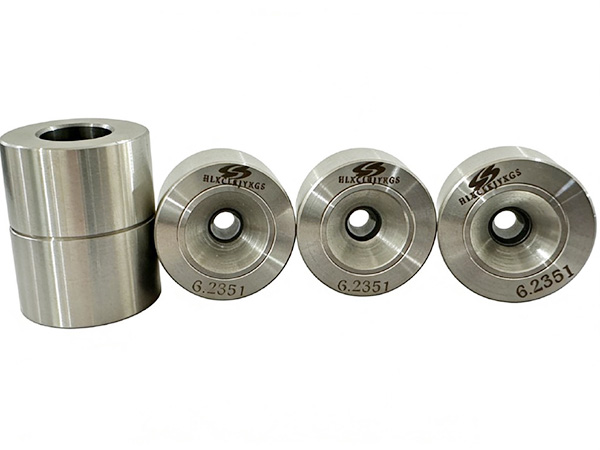
Material Selection: The Foundation of Die Wear Resistance
The most fundamental decision affecting drawing die service life is die material selection. Matching material properties to application requirements eliminates the most common cause of premature wear—wrong material for the job.
For tungsten carbide drawing dies, carbide grade selection significantly impacts wear resistance. Finer grain sizes (0.2–0.5 μm) produce harder, more wear-resistant dies ideal for long production runs at moderate speeds. However, finer grains also reduce fracture toughness, making these grades more susceptible to cracking under shock loading. Coarser grain sizes (2.0–5.0 μm) provide superior toughness for demanding applications but sacrifice some wear resistance. The practical optimum for most general-purpose wire drawing die applications is a medium grain size (0.8–1.5 μm) with 8–12% cobalt content—a balance of hardness and toughness that provides adequate performance across diverse conditions.
For non-ferrous wire drawing, PCD dies provide 3–5 times the wear resistance of carbide equivalents, directly proportional to the hardness advantage of diamond over carbide. The higher initial cost of PCD drawing dies is justified when production volumes are high enough that extended service life reduces per-meter tooling cost below carbide levels.
Coatings: Enhancing Die Wear Resistance Beyond Base Material
Surface coatings applied to the die bore can significantly enhance die wear resistance beyond what the substrate material alone provides. Physical vapor deposition (PVD) coatings are the most commonly applied to tungsten carbide drawing dies.
Titanium nitride (TiN) coatings increase surface hardness to approximately 2400 HV while reducing friction coefficient against most wire materials. TiN-coated dies typically achieve 25–40% longer service life in stainless steel and high-carbon steel applications compared to uncoated carbide.
Titanium aluminum nitride (TiAlN) coatings offer superior hot hardness—the coating maintains its hardness at elevated temperatures, making it particularly effective for high-speed drawing applications where die temperatures are elevated. Service life improvements of 35–60% are documented for TiAlN-coated dies in high-speed copper wire drawing.
Diamond-like carbon (DLC) coatings provide extremely low friction coefficients and high hardness. DLC is particularly effective for drawing aluminum wire, where its non-stick properties prevent aluminum transfer to the die bore that causes adhesive wear and surface defects.
Coating selection should be based on the specific wire material and operating conditions. Not all coatings provide benefit in all applications—TiN and TiAlN coatings are most effective for ferrous wire; DLC performs best for aluminum and copper.
Optimizing Drawing Speed for Extended Die Life
Drawing speed is a primary driver of die wear rate through its direct effect on interface temperature and lubrication regime. Higher speeds generate more frictional heat, accelerate lubricant degradation, and increase the rate of all wear mechanisms. However, slower speed means lower productivity—so the optimization challenge is finding the speed that maximizes the economic return from the speed-versus-life tradeoff.
The critical speed concept helps frame this optimization. Below the critical speed, lubricant film is stable and wear rate is proportional to speed. Above the critical speed, lubricant film breaks down, metal-to-die contact increases dramatically, and wear rate accelerates faster than linearly with speed. Operating just below the critical speed achieves near-maximum productivity with near-minimum wear rate.
For most tungsten carbide drawing die applications, operating at 70–85% of critical speed provides an optimal balance. Specific critical speeds vary by wire material, lubricant, and die geometry—but the principle is universal: modest speed reductions can yield disproportionately large wear rate reductions.
Lubrication Optimization for Die Wear Reduction
Lubrication is the single most impactful operational factor in drawing die service life. Adequate lubrication separates the wire from the die bore, preventing the direct metal-to-metal contact that causes adhesive wear, excessive heat, and surface damage.
For steel wire drawing, dry lubrication using soap-based compounds carried on phosphate or borax-coated wire is standard. The coating must be uniformly applied and properly adherent—gaps in the coating expose bare metal to the die bore, causing immediate adhesive wear and surface defects. Implementing automated coating application with thickness monitoring ensures consistent coverage.
For copper and aluminum wire, emulsion lubricants provide both cooling and boundary lubrication. Lubricant concentration must be maintained within supplier-specified ranges—too concentrated wastes product and may cause foaming; too dilute provides inadequate lubrication. Temperature control is equally important: viscosity, and therefore film thickness, varies with temperature. Maintaining lubricant temperature within ±3°C prevents variation in film thickness that causes inconsistent wear rates.
Process Parameter Control and Monitoring
Consistent process parameters produce consistent die wear rates. Variability in reduction ratio, incoming wire diameter, and drawing tension causes the die to experience fluctuating stress conditions that accelerate wear and make wear prediction unreliable.
Implementing statistical process control (SPC) on key parameters—reduction ratio per pass, lubricant temperature and concentration, drawing speed, and incoming wire diameter—reduces parameter variability and extends drawing die service life by 15–25% compared to operations without SPC. Fewer stress fluctuations mean more predictable wear rates and more accurate die replacement timing.
In-line diameter monitoring serves double duty: it detects when wire quality is degrading, indicating die wear, and it enables die replacement before scrap-generating out-of-tolerance product is produced. Modern laser micrometer systems with real-time SPC charting alert operators when diameter drift trends suggest a die is approaching end-of-life.
Structured Die Maintenance and Reconditioning Programs
For tungsten carbide drawing dies, a structured maintenance and reconditioning program is essential for maximizing service life value. Dies should be tracked individually throughout their lifecycle, with documented inspection data at each stage.
Inspection protocols should include: bore diameter measurement at every die change, surface roughness measurement at bearing zone (Ra trending up indicates wear progression), visual inspection for cracks in approach zone (thermal fatigue indicator), and eccentricity measurement between bore and shell mounting (indicates insert shift).
Reconditioning should be scheduled when bore diameter has increased by 0.05–0.10mm from original, or when surface roughness has degraded beyond application requirements. Reconditioning restores the die to original geometry and surface quality at approximately 25–35% of new-die cost, typically allowing 3–5 cycles before the die reaches minimum wall thickness limits.
Frequently Asked Questions
Q1: What is the most effective way to reduce drawing die wear in stainless steel wire production?
Stainless steel's high hardness and tendency to work-harden make it highly abrasive. Recommended approach: select fine-grain carbide grade (0.5–0.8 μm) or apply TiAlN coating; reduce drawing speed to 60–70% of critical speed for stainless; ensure excellent lubrication with boundary EP additives; implement frequent die inspection to replace before severe wear. Combined, these measures typically reduce wear rate by 40–60% compared to standard practices.
Q2: How much does coating extend drawing die service life?
TiN coatings extend carbide die life by 25–40% in ferrous applications. TiAlN coatings extend life by 35–60%, particularly in high-speed or elevated-temperature applications. DLC coatings extend aluminum wire die life by 30–50%. Coating cost is typically 15–25% of new-die cost, making coatings economical when die life extension exceeds approximately 20%.
Q3: How can I predict when a drawing die will need replacement?
Combine historical wear rate data with real-time monitoring. Track bore diameter over time under known production conditions to establish wear rate curves for each die type and application. Use in-line diameter monitoring to detect when wire diameter approaches tolerance limits. Replace dies proactively at 80–90% of predicted wear life rather than waiting for failure—this approach reduces scrap from out-of-tolerance product.
Q4: Does reducing drawing speed always extend die life?
Below the critical speed for lubricant film formation, wear rate is roughly proportional to speed, so modest reductions do extend life. However, there is a floor effect: below approximately 40% of critical speed, further reduction yields diminishing returns. Operating below this floor may actually increase adhesive wear as the low speed prevents adequate hydrodynamic lubrication. Target 70–85% of critical speed for optimal balance.
Q5: What is the optimal carbide grade for general-purpose wire drawing?
A medium-grain carbide (0.8–1.5 μm grain size) with 8–12% cobalt content provides the best balance of hardness, toughness, and cost for most general-purpose applications. Fine-grain grades (0.2–0.5 μm) offer maximum wear resistance for long runs of non-abrasive wire. Coarse-grain grades (2.0–5.0 μm) are reserved for demanding applications with high impact loading or very abrasive materials.
Conclusion
Improving drawing die service life requires a systematic, multi-factor approach: select appropriate die material and grade for the application, apply coatings where they deliver measurable return, optimize drawing speed against the critical speed for lubricant film stability, maintain lubrication systems rigorously, implement SPC on process parameters, and establish structured die maintenance and reconditioning programs. Each factor contributes incrementally, but their combined effect can extend die wear resistance by 100–200% compared to uncontrolled operations—transforming die cost from a variable expense into a manageable, predictable element of wire manufacturing cost.
References
Thompson, J., & Williams, P. (2023). Abrasive Wear Mechanisms in Tungsten Carbide Wire Drawing Dies. Wear, 518-519, 204712.
Chen, W., & Martinez, C. (2023). PVD Coating Performance Enhancement for Wire Drawing Die Applications. Surface and Coatings Technology, 458, 129358.
Kumar, R., & Anderson, E. (2022). Critical Speed Optimization for Extended Die Life in High-Speed Wire Drawing. Journal of Manufacturing Science and Engineering, 144(6), 061005.
ASTM International. (2023). Standard Specification for Tungsten Carbide Dies for Wire Drawing (ASTM B702-23). West Conshohocken, PA.
Wire Association International. (2023). Best Practices for Drawing Die Maintenance and Lifecycle Management. Guilford, CT: WAI Publications.