Current location:
Custom Drawing Die Solutions for Special Wire Applications
2026-07-24Standard custom dies off the shelf handle the vast majority of wire drawing jobs well enough. But every experienced production engineer eventually runs into that one application where catalog specs just don't cut it—the unusual alloy that tears instead of drawing cleanly, the profile shape that keeps going out of tolerance, or the wire surface that refuses to come clean no matter how many passes you run. That is where custom drawing die solutions earn their keep. A specialized die manufacturer with the right engineering depth can design tooling tailored to the specific material behavior, equipment limitations, and quality targets that generic dies were never meant to address. This article walks through when custom solutions make sense, what the design process looks like, and how partnering with the right die manufacturer changes the outcome from frustration to reliable production.
When Standard Dies Stop Being The Answer
Over years of working with wire producers across different sectors, a handful of situations keep coming up where standard custom dies simply cannot deliver. Understanding these scenarios helps buyers recognize when it is time to ask for a custom approach rather than trying to force a standard product into a role it was never designed for.
Unusual wire materials top the list. Nickel-titanium shape memory alloys, cobalt-chromium medical grades, and fine-grain beryllium copper all behave differently during cold working than standard steel or copper. Their work-hardening rates, friction characteristics, and surface adhesion properties are distinct enough that standard die geometries generate excessive wear, poor surface finish, or inconsistent mechanical properties. A custom die manufacturer designs around these specific material behaviors rather than treating them as annoyances to be worked around.
Non-round profiles represent another common trigger. Flat wire, square wire, hexagonal profiles, and shaped sections for specialized applications have flow characteristics that round dies never encounter. The material distributes unevenly across the die opening, requiring approach geometry and bearing length design that accounts for the shape-specific stress distribution. Standard dies simply cannot provide the controlled reduction that shaped wire demands.
Extreme quality specifications—tolerance below ±0.003mm on diameter or surface finish below Ra 0.02 μm—push standard dies beyond their design limits. Meeting these specs requires bore geometry optimized for the specific material, polishing sequences tailored to the die material grade, and inspection protocols that verify parameters standard manufacturers do not bother measuring.
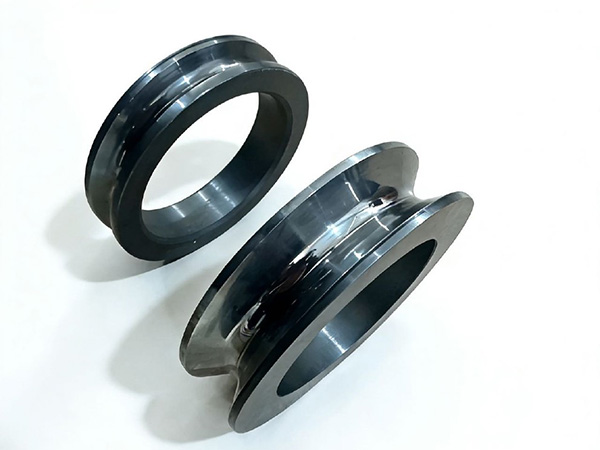
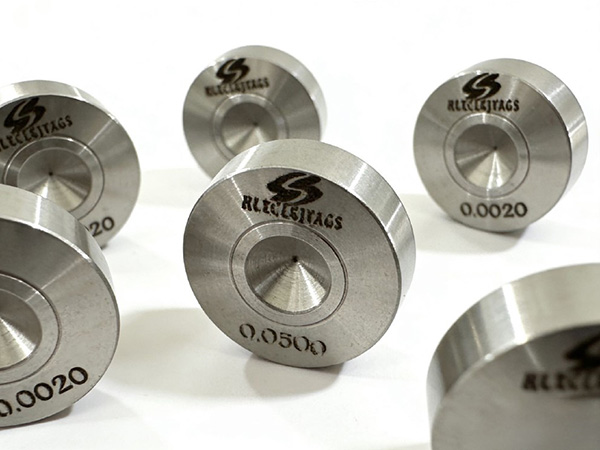
How A Die Manufacturer Approaches Custom Design
The process a reputable die manufacturer follows for custom dies differs fundamentally from ordering standard products. Instead of picking from a catalog, the manufacturer collects detailed application data, simulates the drawing process, and engineers the die geometry around the specific material and production parameters.
The first step is a technical consultation where the manufacturer gathers specifics: wire material chemistry and incoming hardness, starting and target diameters, reduction schedule across all passes, drawing speed range, lubricant type and application method, machine type and die mounting configuration, and quality targets including tolerance and surface finish. This information forms the design basis. Without it, any custom die is essentially a guess dressed up with a higher price tag.
Next comes geometry design. The die manufacturer determines the optimal approach angle based on the material's work-hardening curve—a steeper angle for materials that harden slowly, a shallower angle for those that stiffen rapidly. Bearing length gets calculated from the combination of reduction ratio and material flow properties. The transition geometry between approach and bearing zones is designed to eliminate stress concentration points that can cause wire surface tearing or internal cracking.
Modern die manufacturers increasingly use finite element simulation to model the drawing process before cutting steel. This step visualizes how the material will deform, where stress concentrations occur, and whether the predicted drawing force falls within the equipment's capability. Simulation catches design problems early, when they are cheap to fix, rather than after a physical die has been manufactured and tested at the customer's expense.
Material Selection Becomes Application-Specific
Standard die manufacturers typically offer one or two carbide grades because they need to keep inventory simple. A custom die supplier, by contrast, selects the carbide grade specifically for the application. This freedom is one of the most valuable aspects of working with a manufacturer who builds custom solutions.
For drawing abrasive nickel alloys, a submicron carbide grade with 6% cobalt provides maximum wear resistance even though it sacrifices some toughness. For interrupted drawing operations where thermal cycling is severe, a medium-grade carbide with 12% cobalt absorbs the thermal stress without microcracking. For applications where the wire must emerge with a mirror finish, the die manufacturer selects a grade known for its polishability and applies the appropriate diamond compound sequence to reach the target surface roughness.
Coatings also become available options. A custom die manufacturer can apply TiAlN coating for high-temperature applications, DLC coating for aluminum wire that tends to gall, or specialized multilayer coatings for particular abrasive conditions. Standard die suppliers rarely offer this level of customization because it disrupts their production flow.
Validation Through Production Trials
A custom drawing die design is only as good as its real-world performance. Good die manufacturers build a validation phase into their custom project workflow, typically producing one or two sample dies for customer testing before committing to volume production.
The trial process involves running the sample die under the customer's actual production conditions—same wire material, same speed, same lubricant, same machine. Performance data collected during the trial includes drawing force (compared against predicted values), wire surface finish measured by profilometer, diameter consistency over the trial run length, and visual inspection for surface defects. The die manufacturer reviews these results with the customer, identifies any adjustments needed, and modifies the design accordingly.
This iterative validation is what separates custom dies from standard products that simply get swapped when they do not work. A manufacturer invested in the custom approach treats the first die as the beginning of the refinement process, not the end. The result is a die that arrives already optimized for the specific application rather than one that needs field modifications to become usable.
Cost Considerations and ROI
Custom dies cost more than standard products. The premium covers engineering time, simulation work, sample die production, and the validation process. Depending on complexity, a custom dies supplier might charge 50–150% above standard pricing for a tailored solution.
The economic question is whether the premium pays for itself. Experience across multiple industrial applications suggests it almost always does when the application genuinely requires it. Consider a stainless steel wire producer who struggled with 4% surface rejection rate using standard dies. A custom die optimized for their specific alloy and drawing conditions reduced rejects to 0.5%. At that producer's volume, the savings from reduced scrap paid for the custom die investment in under three weeks. The die itself lasted longer too, because the geometry was matched to the material rather than being a one-size-fits-all approximation.
The return calculation should factor in scrap reduction, die life extension, reduced downtime from fewer die changes, and the value of being able to meet quality specifications that standard dies could not achieve. When all these factors are counted, custom dies often deliver a net positive ROI even at the higher initial cost.
Frequently Asked Questions
Q1: How long does it take a die manufacturer to produce custom dies?
For simple modifications to existing designs—adjusting approach angle or bearing length on a standard geometry—the timeline is typically 3–5 weeks including validation. For completely new designs involving simulation and multiple trial iterations, expect 6–10 weeks from initial consultation to production-ready tooling.
Q2: What information does a die manufacturer need to design custom dies?
The manufacturer needs wire material specification including chemistry and hardness, starting and final diameter, total reduction and per-pass reductions, drawing speed range, lubricant type, machine configuration, and quality targets for diameter tolerance and surface finish. The more data you provide, the closer the first design will be to the final solution.
Q3: Can custom dies be reconditioned the same way as standard dies?
Yes. Custom carbide dies can be reconditioned 3–5 times just like standard products, provided the die manufacturer documents the original geometry precisely. The reconditioning cost remains the same percentage of the custom die's original price. Keep the original die specification sheet accessible so the reconditioning shop can restore the correct geometry.
Q4: What happens if a custom die does not perform as expected during trial?
A reputable die manufacturer treats the trial as a joint troubleshooting exercise. The die is analyzed for geometry deviation, surface condition, and wear patterns. Adjustments are made—sometimes to the die itself, sometimes to the process parameters—and a revised version is produced. The cost of the first revision is typically covered by the manufacturer as part of the custom development agreement.
Q5: How many custom dies should I order for a trial?
One to three dies is standard for the trial phase. One die confirms basic functionality; two to three dies provide data on manufacturing consistency. Once the design is validated, scale up to the full production quantity. Avoid committing to large volumes before validation—the whole point of custom development is to get the design right first.
Conclusion
Custom drawing die solutions address the applications where standard tooling falls short—unusual materials, non-round profiles, and extreme quality requirements that off-the-shelf products were never designed to meet. The higher initial investment pays for itself through reduced scrap, improved quality, and longer die life when the application genuinely requires custom engineering. Work with a die manufacturer who brings application engineering depth, simulation capability, and a structured validation process. A well-executed custom die is not a premium expense—it is the most cost-effective solution for applications where standard tooling cannot deliver the result your production schedule and customer quality expectations demand.
References
Lee, J., & Park, S. (2023). Finite Element Simulation of Custom Die Geometries for Non-Ferrous Wire Drawing. Journal of Materials Processing Technology, 305, 117589.
Williams, P., & Chen, T. (2022). Carbide Grade Selection for Custom Die Applications in Specialty Wire Manufacturing. International Journal of Refractory Metals and Hard Materials, 104, 105801.
Anderson, R., & Taylor, M. (2023). Cost-Benefit Analysis of Custom Die Development vs. Standard Tooling in Precision Wire Production. Journal of Manufacturing Science and Engineering, 145(5), 051008.
Das, S., & Kumar, V. (2023). Validation Methodologies for Custom-Designed Wire Drawing Dies. Materials Today: Proceedings, 72, 2138-2144.
Huang, X., & Tanaka, K. (2022). Coating Selection Framework for Specialized Drawing Die Applications. Surface and Coatings Technology, 441, 128533.