Current location:
Best Materials Used for Drawing Dies in Wire Manufacturing
2026-06-25The selection of materials used for drawing dies is one of the most consequential decisions in wire manufacturing tooling strategy. Die material directly determines wear resistance, achievable surface finish, fracture toughness, service life, and total cost of ownership. With options ranging from hardened tool steel to single-crystal diamond, manufacturers must match material properties to application requirements to achieve optimal performance economics. This article provides a technical comparison of the principal drawing die materials and practical guidance for selecting the appropriate material for specific wire drawing applications.
Why Material Selection Matters in Drawing Die Performance
Drawing dies operate under demanding conditions: high bearing pressures (often exceeding 1000 MPa for steel wire), elevated temperatures from frictional heating, and continuous sliding contact that generates abrasive wear. The die material must resist these conditions while maintaining precise bore geometry and surface quality throughout its service life. Material properties that determine performance include:
Hardness determines resistance to abrasive wear from the wire surface. Harder materials maintain bore geometry longer under abrasive conditions.
Fracture toughness determines resistance to cracking from thermal shock, impact loading during wire threading, and stress concentrations at geometric features.
Thermal conductivity determines the rate at which frictional heat is conducted away from the wire-die interface, affecting operating temperature and the risk of thermal damage.
Polishability determines the minimum achievable surface roughness, which directly controls wire surface finish quality.
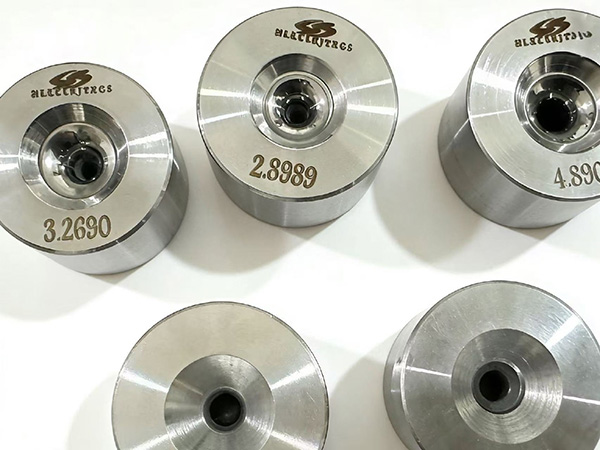
Tungsten Carbide: The Industry Standard for General-Purpose Dies
Tungsten carbide drawing dies represent approximately 75% of all wire drawing dies used globally, and for good reason. Cemented carbide—a composite of tungsten carbide (WC) particles in a cobalt binder—delivers an exceptional combination of hardness, toughness, and cost-effectiveness that no other material can match across the broad range of industrial wire drawing applications.
Hardness: Vickers hardness of 1500–2000 HV, depending on grain size and cobalt content. This provides adequate wear resistance for most wire materials including low-carbon steel, stainless steel, copper, and aluminum.
Fracture toughness: 9–15 MPa√m, significantly higher than ceramics or diamond. This toughness margin prevents catastrophic failure under the shock loading that occurs during wire threading and tension fluctuations.
Polishability: Carbide dies can be polished to Ra of 0.05–0.15 μm, suitable for most industrial applications where excellent but not mirror-quality surface finish is required.
Cost: Carbide dies typically cost $30–100 for common sizes—60–80% less than equivalent PCD dies and 90% less than natural diamond dies.
Reconditionability: Carbide dies can be reground and repolished 3–5 times at 25–35% of new-die cost per cycle, dramatically reducing effective tooling cost over the die's complete service life.
The primary limitation of tungsten carbide dies is wear rate when drawing abrasive wire materials at high speeds. For these demanding applications, diamond die materials become economically advantageous despite higher initial cost.
Polycrystalline Diamond (PCD): Superior Performance for Non-Ferrous Wire
PCD drawing dies are manufactured from synthetic polycrystalline diamond compact sintered at high pressure and temperature. The random orientation of diamond grains produces isotropic properties—uniform hardness and wear resistance in all directions—while the intergranular cobalt binder provides toughness that prevents the catastrophic fracture seen in single-crystal materials.
Hardness: Vickers hardness exceeds 5000 HV, approaching that of natural diamond. This extreme hardness produces wear rates 3–5 times lower than carbide in equivalent applications.
Wear behavior: Unlike natural diamond, PCD wears uniformly in all directions, maintaining round bore geometry as wear progresses. This extends useful service life beyond what absolute wear rate alone would suggest.
Thermal conductivity: PCD exhibits thermal conductivity of 200–400 W/mK—six to ten times that of tungsten carbide. This enables efficient heat removal from the drawing zone, allowing higher drawing speeds without thermal damage.
Optimal applications: PCD drawing dies excel in drawing non-ferrous wire—copper, aluminum, gold, silver—particularly at smaller diameters (below 1.0mm) and higher drawing speeds (above 1000 m/min). They are the standard choice for copper magnet wire production, where surface finish directly affects insulation adhesion and motor reliability.
Natural Diamond: The Choice for Ultra-Fine and Premium Wire
Natural diamond drawing dies are manufactured from carefully selected single-crystal diamond stones. The oriented crystal structure can be polished to an atomically smooth surface—Ra below 0.02 μm—that produces wire with flawless surface quality unattainable with any other die material.
Surface finish capability: Natural diamond achieves the smoothest possible surface on both the die bore and the resulting wire. This makes natural diamond drawing dies the only choice for ultra-fine wire below 0.05mm, precious metal wire for jewelry, and bonding wire for semiconductor packaging.
Size limitations: Natural diamond dies are limited by the availability of suitable stones. Practical bore diameter range is approximately 0.02–0.5mm. Larger natural diamond dies become prohibitively expensive due to stone cost.
Anisotropic wear: Single-crystal diamond wears at different rates in different crystallographic directions. This causes the bore to become elliptical as wear progresses, limiting useful service life before bore geometry drifts beyond tolerance.
Brittleness: Natural diamond has fracture toughness of only 3–5 MPa√m—one-third to one-half that of PCD. This makes natural diamond dies more susceptible to cracking from thermal shock or mechanical impact.
Specialty Die Materials for Specific Applications
Beyond the three primary drawing die materials, specialty options address specific application requirements:
Coated carbide dies: Physical vapor deposition (PVD) coatings—TiN, TiAlN, DLC—applied to carbide substrates enhance surface hardness and reduce friction. Coatings can extend carbide die life by 30–60% in abrasive applications such as stainless steel wire drawing.
Ceramic dies: Silicon nitride and other advanced ceramics offer extreme hardness and chemical inertness for specific corrosive or high-temperature applications. Their brittleness limits use to low-shock applications.
Tool steel dies: Hardened tool steel dies are economical for drawing soft wire at low speeds and small batch sizes. Their wear rate is 5–10 times higher than carbide, making them unsuitable for production-scale manufacturing.
Cost-Performance Comparison of Drawing Die Materials
Selecting the optimal die material requires balancing performance benefits against cost premiums. The following comparison provides general guidance:
Tungsten carbide: Lowest initial cost; adequate performance for most wire diameters above 0.5mm; reconditioning capability maximizes lifetime value. Optimal for general-purpose steel, copper, and aluminum wire drawing.
PCD: 2.5–4 times the initial cost of carbide; 3–5 times the wear life in suitable applications; superior surface finish; higher maximum drawing speeds. Optimal for non-ferrous wire below 1.0mm where surface finish matters.
Natural diamond: 8–15 times the initial cost of carbide; unequaled surface finish capability; size-limited to below 0.5mm. Optimal only for ultra-fine wire, precious metals, and applications demanding flawless surface quality.
For most industrial wire manufacturers, tungsten carbide drawing dies provide the optimal cost-performance balance for wire above 0.5mm. PCD dies become advantageous for high-volume non-ferrous wire production below 1.0mm. Natural diamond dies remain essential for ultra-fine and premium wire that no other material can produce.
Selecting the Right Die Material: Decision Framework
Use the following decision framework to select materials used for drawing dies for your specific application:
Step 1: Define wire material and diameter. Ferrous wire (steel, stainless) typically uses carbide dies. Non-ferrous wire (copper, aluminum, precious metals) benefits from PCD at smaller diameters and higher speeds.
Step 2: Determine surface finish requirements. For critical surface quality applications—magnet wire, medical wire, jewelry—diamond materials become necessary. For general industrial applications, carbide is adequate.
Step 3: Assess production volume. High-volume production amortizes the premium cost of diamond dies across more meters of wire. Low-volume production favors the lower initial cost of carbide.
Step 4: Calculate total cost of ownership. Include initial cost, expected service life, reconditioning potential, downtime for die changes, and quality costs. The lowest initial cost die is rarely the lowest total cost die.
Frequently Asked Questions
Q1: Can PCD dies be used for drawing steel wire?
PCD can draw mild steel at moderate speeds, but the advantage over carbide diminishes because the higher hardness and drawing forces of steel accelerate PCD wear. For carbon steel and stainless steel wire, tungsten carbide—or coated carbide for improved performance—remains the standard recommendation.
Q2: How much longer do PCD dies last compared to carbide?
In equivalent non-ferrous applications—copper wire drawing at similar diameters and speeds—PCD dies typically achieve 3–5 times the service life of carbide dies. However, PCD's superior bore geometry retention extends useful life beyond what absolute wear rate alone suggests.
Q3: Are coated carbide dies worth the cost premium?
For abrasive wire materials—stainless steel, high-carbon steel—coated carbide dies typically deliver 30–60% longer life than uncoated carbide. For copper and aluminum drawing, coatings provide minimal benefit and the premium cost is usually not justified.
Q4: At what wire diameter should I switch from carbide to PCD?
There is no universal threshold, but for copper wire production above 500,000 meters per month, PCD typically becomes economical at diameters below 1.0mm. For smaller operations or less demanding surface quality requirements, carbide remains cost-effective to smaller diameters. Conduct a site-specific cost comparison for accurate guidance.
Q5: Can natural diamond dies be reconditioned?
Generally no. The single-crystal structure cannot be effectively reground, and the precision required for ultra-fine bore diameters precludes material removal. Natural diamond dies are typically replaced when worn, which reinforces the importance of protecting them from mechanical damage and thermal shock.
Conclusion
The materials used for drawing dies—tungsten carbide, polycrystalline diamond, and natural diamond—each offer distinct performance and cost profiles suited to specific application requirements. Carbide provides the optimal balance of hardness, toughness, and cost for general-purpose wire drawing above 0.5mm. PCD excels in non-ferrous wire production where superior surface finish and extended service life justify its cost premium. Natural diamond remains essential for ultra-fine wire and applications demanding flawless surface quality. Select die material based on technical application requirements first, then optimize for total cost of ownership. Partner with die suppliers who offer multiple material options and can recommend the appropriate choice for your specific wire product. The right material selection pays for itself many times over through longer die life, higher quality, and lower total tooling cost.
References
Johnson, A., & Williams, P. (2023). Comparative Performance of Tungsten Carbide and PCD Dies in Copper Wire Drawing. Journal of Materials Processing Technology, 312, 117834.
Wang, Q., & Thompson, R. (2022). Wear Behavior and Service Life Prediction for Drawing Die Materials. International Journal of Refractory Metals and Hard Materials, 108, 105924.
Chen, W., & Martinez, C. (2023). PVD Coating Effects on Tungsten Carbide Die Performance in Steel Wire Drawing. Surface and Coatings Technology, 458, 129358.
ASTM International. (2023). Standard Specification for Tungsten Carbide Dies for Wire Drawing (ASTM B702-23). West Conshohocken, PA.
European Precision Tooling Association. (2023). Guide to Drawing Die Material Selection and Application. Brussels: EPTA Publications.